

When I was tasked to create a ‘whole school reading’ ethos back in April 2018, I initially thought I would need super hero powers! Whilst I’m into my second year, and have achieved many successes, I still sometimes feel like I could do with a little bit of supernatural help!
So, let me take you back to April 2018. I had the summer term to prepare the launch of our Tutor Reading Programme in the September and also to create a positive whole school approach to reading – easy peasy, right?! I’ve never seen a ‘to do’ list so astronomical! Fortunately, I was able to visit a school where a Tutor Reading Programme was already running smoothly with some great measurable impact on students’ reading ages. It was a much smaller school though, 600 students in comparison to our 1200+ and it was a bit of a mathematical nightmare for me working out the amount of books to order! (Numbers are definitely not my strong point!) We also ran it slightly different, with SLT deciding only Years 7-10 would take part and for 3 mornings per week – the other 2 being dedicated to PSHE and assemblies. I was slightly concerned that 3 mornings per week would not be enough consistency for students to follow along with the book – but it was better than nothing, and having seen it run successfully, I was sure the programme would have the same positive impact in our setting. So I set about putting it into action.
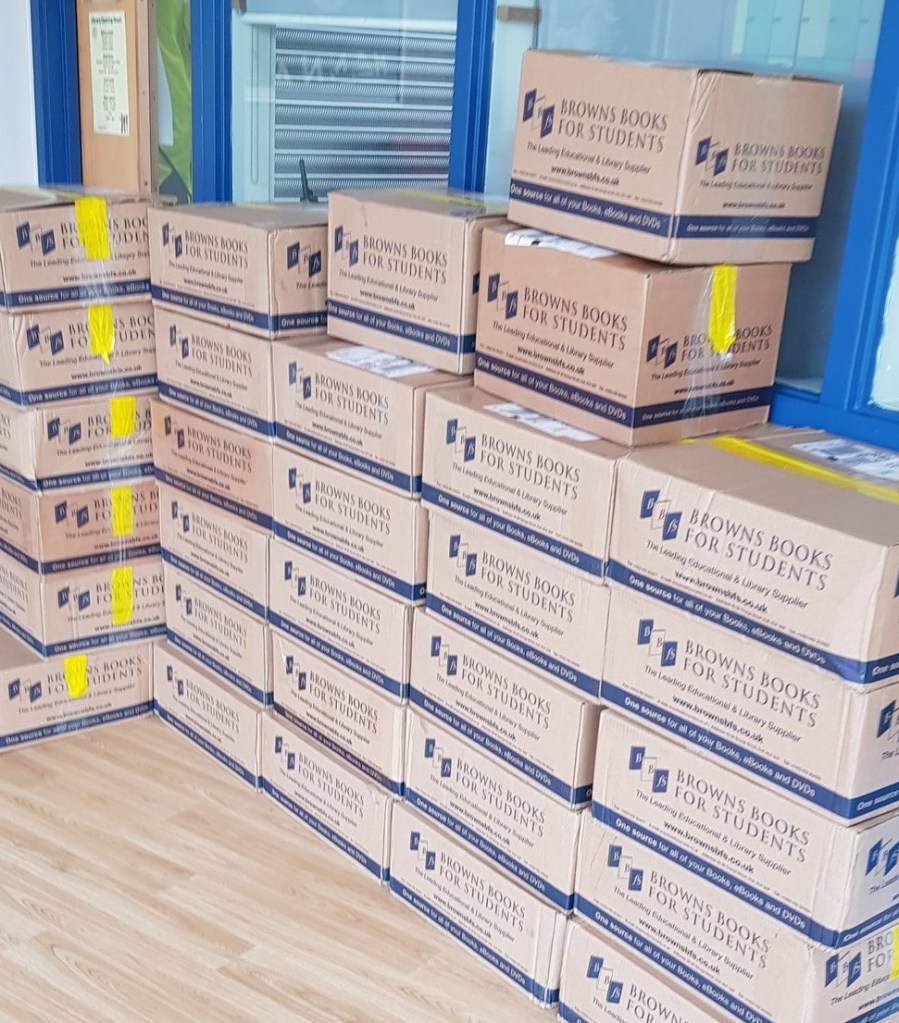
And then the books arrived! I’m not going to lie – this took me a solid 2 days during the summer holidays to unpack and sort out! Not sure I’d ever seen so many books in my life! It was very exciting but very daunting and I knew that I’d have to set up some sort of tracking document as these books were a huge investment from the school and needed to be looked after. (One of the many ‘bugbears’ of this part of the role – much of my budget unfortunately goes on replacing missing books.)
I also had to create some staff guidelines and prepared a presentation for all staff to be delivered during the September training days. Importantly, this initiative was highly prioritised by SLT, meaning I felt staff took it more ‘seriously’ as a whole school priority. Not that I doubted myself or the programme, but for someone who suffers from ‘imposter syndrome’ it was definitely comforting that the principal ‘had my back’ as they say.
Of course, the book choice is vital for making this programme work, and I mainly used the book list from the school I visited as they seemed to be well liked. I also made sure there was one non-fiction book and one pre-19th century text to fill the ‘cultural capital’ quota I’d been given. With more students reading, we needed more sets of books, so I consulted my fellow English teacher colleagues and fabulous librarian for some recommendations. We have some great books and some personal favourites including ‘Chinese Cinderella’ (which I remember reading as a child) ‘The Boy in the Striped Pyjamas’, and some great contemporary non-fiction which I don’t normally read, but particularly enjoyed ‘Mud, Sweat and Tears’ by Bear Grylls with my own tutor group (my tutees enjoyed it too!) Another highlight of our book list was being able to choose titles that fit in well with our Character Curriculum ethos, meaning many of the books showcased our core values of respect, determination and ambition. I mean, I’m not going to take all the credit, but we did get the ‘School of Character’ kitemark in the same year as the Tutor Reading Programme was launched! (Second school in the country to be awarded with it, might I add!!)

The programme has been a great success and a major part of that has been down to tracking the consistency of it – on a daily basis. SLT members are on duty every morning and monitor Tutor Reading thoroughly – making sure students follow along with bookmarks (a great visual method of making sure students are reading along, and not just listening – our principal’s favourite phrase being “it’s not a Tutor Listening Programme!”)
The tracking document works well (mostly!) and staff tend to stick to the 2 days notice period of needing a new book – although there’s always some mornings when a student arrives at my desk requesting a new set after registration has already started! A few other teething problems that arose was staff confidence with reading. We have dyslexic staff, MFL teachers who aren’t native English speakers, and staff who just aren’t confident at reading aloud. However, this was solved by creating a buddy system – where members of staff who aren’t tutors pop in one morning a week to do the reading. We’ve also extended it this year to provide a leadership opportunity for our Sixth Formers. We have well over 15 Sixth Form students who read regularly for tutors once a week, and also help with monitoring students’ usage of bookmarks – a great support for our teaching staff and a great way to build staff/student relationships with our Sixth Formers.
Another element launched this September was the Knowledge Organiser – a phrase that now fills me with dread! Each book – yes, all 37 of them – has its own accompanying knowledge organiser, all made by me (hence the dread!) In fact, it reminds me of that non-fiction book I read with my tutor group – ‘Mud, Sweat and Tears’! They certainly were a chore to make but the value they’ve added to the programme has been immense. Each one has pre and post reading discussion questions, author background, plot overview and context information. There’s also a key vocab box – something vitally important for introducing students to new sophisticated vocabulary. Staff and students have really welcomed them, particularly the discussion as it allows the tutor group to really explore what they are reading. And with that in mind, this January I’m launching ‘Habits of Discussion’ cards to accompany the Knowledge Organisers, which have sentence prompts/starters to help students scaffold their verbal responses in a more sophisticated way. So with my Literacy Co-ordinator hat on, this is a double whammy in exposing students to more sophisticated vocabulary along with oracy skills.
So, if you’re thinking of launching a Tutor Reading Programme in your school, I’d say – do it! It’s a lot of logistical work and you need the support from SLT to make sure everyone ‘buys’ into it, but the outcomes are amazing. Our student reading ages have improved massively since its launch and student surveys are telling us that they are enjoying being read to every morning. And as a teacher – of English or not – what better way to start the day?!
– Check out my resources page soon for Tutor Reading Programme resources, including book lists, tracking documents and knowledge organisers
– Stay tuned for Part 2 where I talk about other strategies to create a ‘whole school reading’ ethos, including LitFest and Summer Reading projects
 Leading Literacy